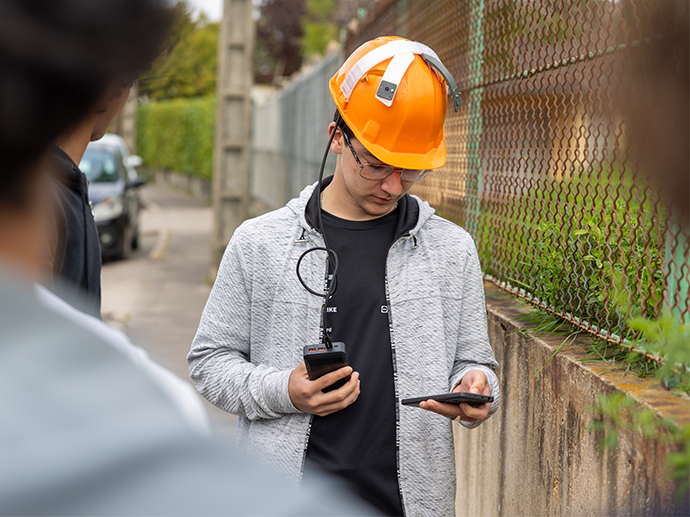
AI Driven Crack Detention / Connected Helmet
Infrastructure inspections are crucial for safety and maintenance, but traditional methods are time-consuming and prone to human error. Innovative digital tools can provide a solution. The BEPROACT pilot at Lycée Les Marcs d’Or in Dijon showcased AI-driven crack detection tools, among which the innovative Connected Helmet, developed by the University of Lille in collaboration with the Bourgogne-Franche-Comté Region. This innovative wearable combines sensors, AI algorithms, and wireless communication to support infrastructure inspections, making it easier to detect cracks and structural defects.
During the pilot session in Dijon, students, researchers, and infrastructure managers had the chance to test the helmet and AI-powered crack detection tools in hands-on exercises. The system delivers real-time visual and auditory feedback, processing data locally to spot anomalies, alert users, and guide inspection procedures. By combining smart sensing, augmented visualization, and machine learning, it enables faster, more accurate decisions while reducing human error and inspection time.
Participants also explored how digitalisation and data-driven methods can improve sustainable building management. The pilot paves the way for future deployments, including IoT sensors planned for 2026 at the Smart Building Viotte site in Besançon.
This initiative demonstrates how intelligent wearable systems can enhance safety, efficiency, and predictive maintenance, combining innovation, practical application, and education in one scalable solution.